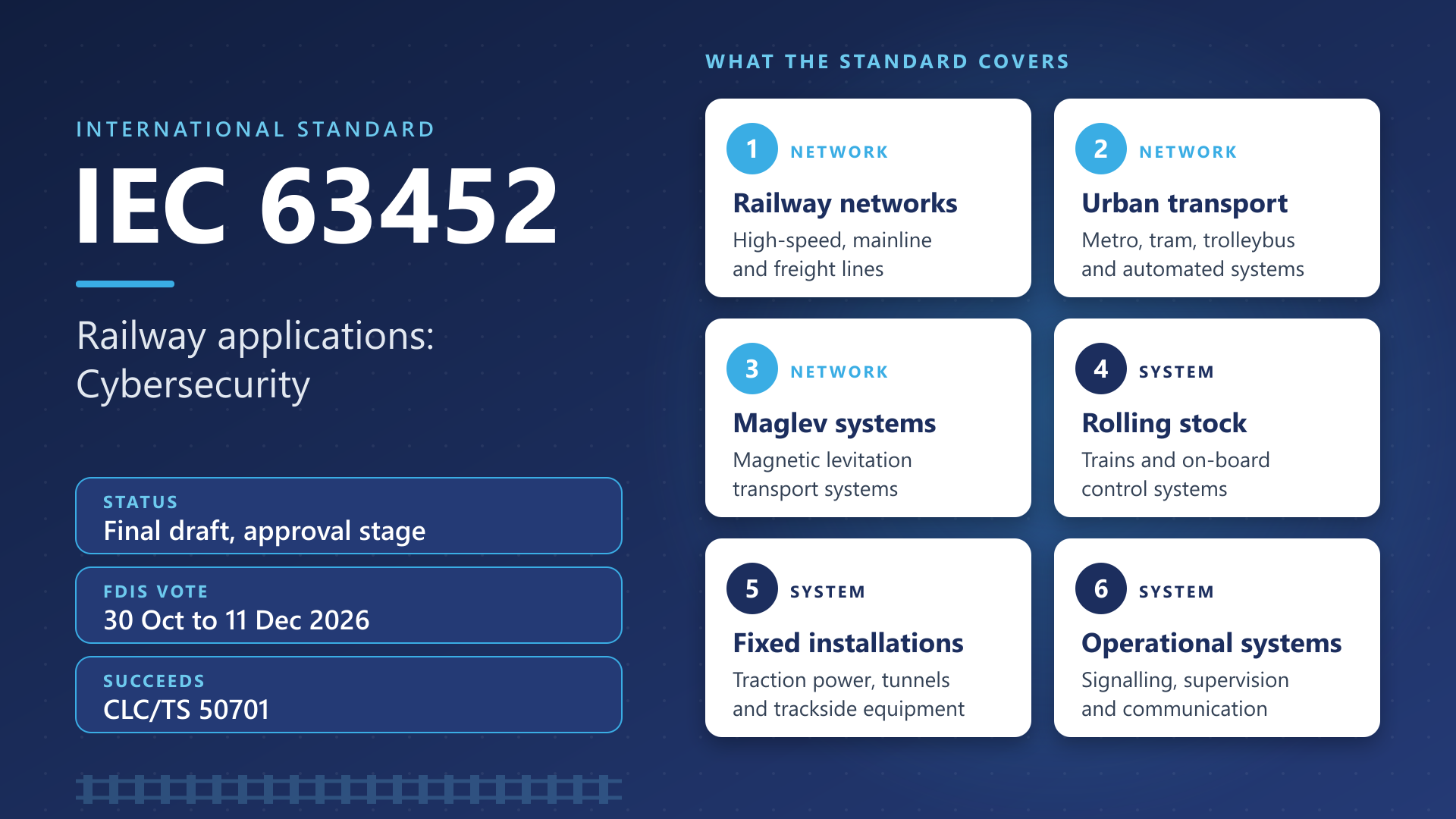
Until now, the main cybersecurity reference written for railways has been CLC/TS 50701, a European Technical Specification. IEC 63452, Railway applications: Cybersecurity, is the first International Standard dedicated to railway cybersecurity, and it is now in its final approval stage at the International Electrotechnical Commission (IEC). It defines the cybersecurity activities and deliverables needed to identify, monitor and manage cybersecurity risk throughout the life of a railway application.
The standard moves railway cybersecurity from activities performed within individual projects to a responsibility that is governed across the organisation and maintained for the full life of each system. This article sets out the key facts, who the standard applies to and what it changes, and then explains the background and each part of the standard.
Key Facts About IEC 63452
| Item | Detail |
|---|---|
| Full title | IEC 63452, Railway applications: Cybersecurity |
| Developed by | IEC Technical Committee 9 (TC 9), Electrical equipment and systems for railways |
| Status | Final Draft International Standard (FDIS), with voting open from 30 October to 11 December 2026 |
| Publication | Expected after a successful FDIS vote. A pre-release version is available on the IEC webstore |
| Replaces | CLC/TS 50701 (first published in 2021, revised in 2023) |
| European adoption | To be adopted in Europe as EN IEC 63452 |
| Builds on | The IEC 62443 series, adapted to the railway sector |
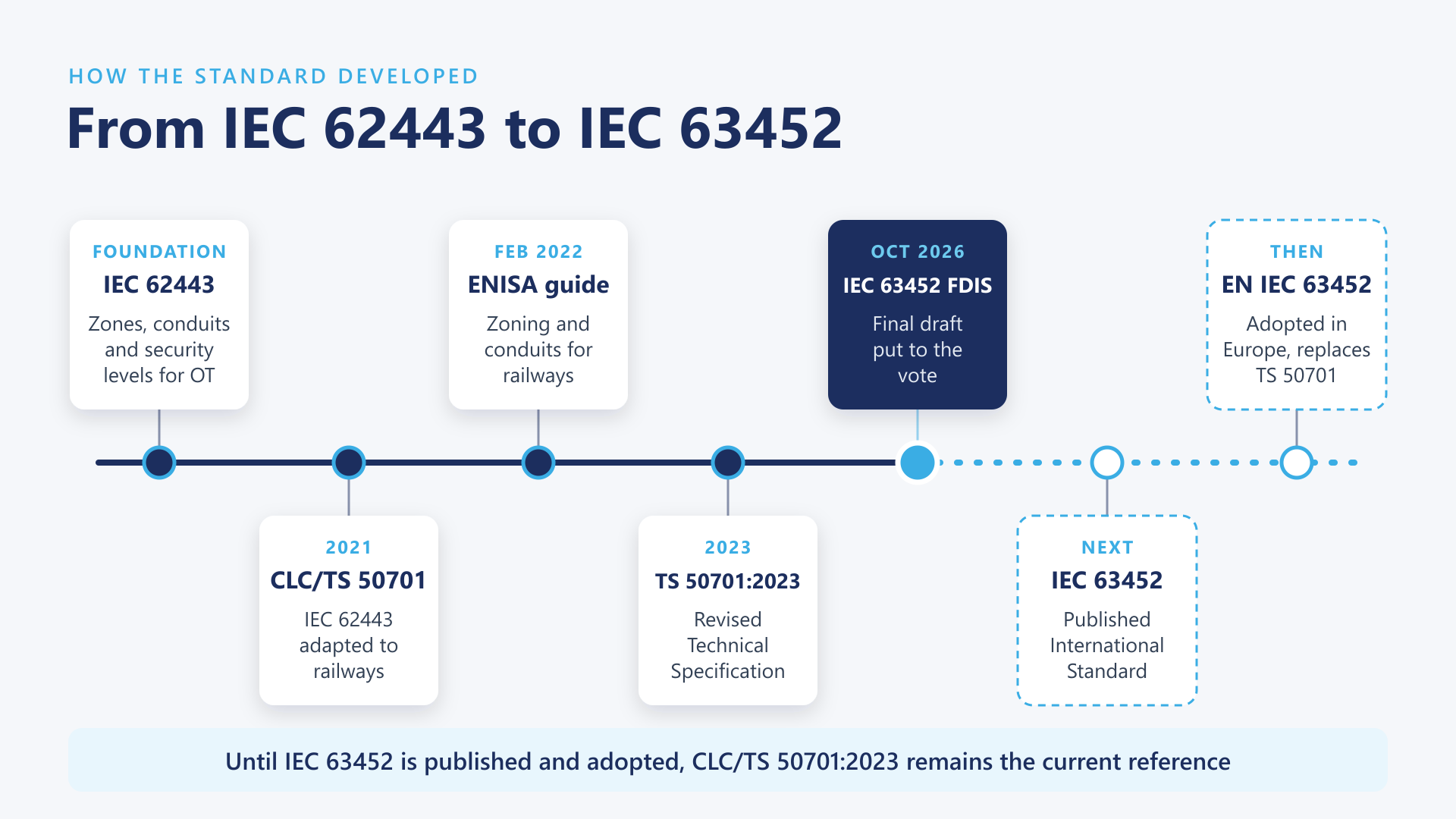
Until IEC 63452 is formally published and adopted, CLC/TS 50701:2023 remains the specification that most railway contracts reference.
Who IEC 63452 Applies To
IEC 63452 applies to every organisation that specifies, builds, supplies or operates the digital systems of a railway. It covers high-speed lines, mainlines and freight lines, urban networks such as metros, tramways, trolleybuses and fully automated systems, and maglev lines. Within those networks, it applies to rolling stock, fixed installations such as traction power and tunnel systems, and operational management systems, which include supervision, communication and signalling.
| Role | Typical organisations | Main responsibility under IEC 63452 |
|---|---|---|
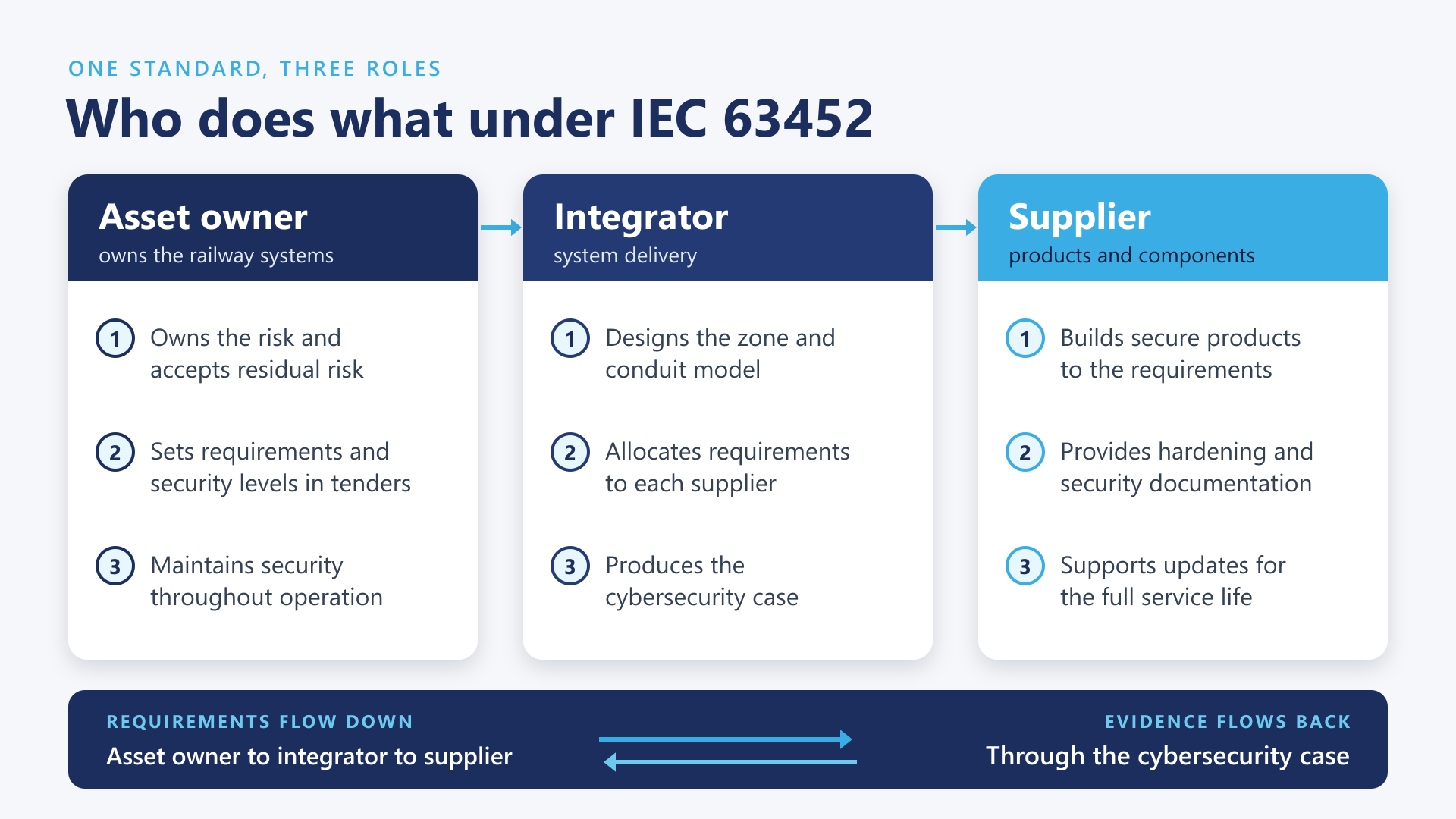
| Asset owner | Infrastructure managers, railway undertakings, and organisations that own and run metro and tram networks | Owns the cybersecurity risk, sets requirements and target security levels in tenders, and maintains security throughout operation |
| System integrator | Signalling, rolling stock and control centre integrators, and main contractors | Designs the zone and conduit model, allocates requirements to each supplier, and produces the cybersecurity case |
| Product supplier | Manufacturers of signalling, train control, communication and traction power equipment | Delivers products that meet the allocated requirements, provides security documentation, and supports updates for the full service life |
Is IEC 63452 Mandatory?
Like most IEC standards, IEC 63452 is voluntary in itself. It becomes binding when a contract or tender cites it, or when a national authority adopts it as a recognised means of compliance. In the European Union, the NIS2 Directive already requires rail infrastructure managers and railway undertakings to manage cybersecurity risk, and IEC 63452 offers a recognised way to demonstrate this. Product manufacturers selling in the European Union must also meet the Cyber Resilience Act.
Key Implications at a Glance
- Cybersecurity becomes an organisational responsibility: Security is governed across the organisation and maintained for the life of each system, rather than closed at commissioning.
- Requirements move into procurement: Asset owners define cybersecurity requirements and target security levels in their tenders, and these flow to integrators and suppliers.
- Evidence replaces general statements: Compliance is demonstrated through verification, validation and a cybersecurity case.
- Security and safety work together: A security change to a safety-related system is assessed within the safety process before it is applied.
- Suppliers commit for the long term: Security updates are expected for the full service life of railway equipment, which is often several decades.
- Existing work remains valid: Organisations that already apply CLC/TS 50701 are building on the same foundation, so the transition is a review of the existing programme rather than a new start.
Why Railways Need a Dedicated Standard
The IEC 62443 series is the international reference for industrial control system security, but a railway differs from a process plant in several important ways.
- Distributed systems: Interlockings, trackside equipment and power systems are spread across hundreds of kilometres of line.
- Safety approval: Signalling is approved through a formal safety case, and even a software patch can affect that approval, so security work must operate within the safety assurance process.
- Long service life: Rolling stock and signalling remain in service for decades, so older systems are a normal part of every railway.
- Moving assets: Trains connect to trackside, depot and maintenance networks, and each connection must be secured.
- Several duty holders: Infrastructure managers, railway undertakings, maintainers and suppliers each own part of the system.
The threat is documented. In May 2017, the WannaCry ransomware affected passenger information displays at Deutsche Bahn. In October 2022, DSB trains in Denmark were halted for several hours after a cyberattack on Supeo, a subcontractor whose application supported train crews. In August 2023, around twenty trains in Poland were stopped by unauthorised radio commands that exploited an analogue radio-stop function that does not authenticate the sender.
Practical implication: None of these incidents required access to the signalling core, which is why a railway standard must address the whole railway system and its supply chain.
From IEC 62443 to IEC 63452
The IEC 62443 series established the concepts of zones, conduits and security levels. In 2021, CENELEC published CLC/TS 50701, which adapted these concepts to railways and aligned them with the EN 50126 life cycle for reliability, availability, maintainability and safety (RAMS). The European Union Agency for Cybersecurity (ENISA) followed in 2022 with Zoning and Conduits for Railways, and a revised Technical Specification was published in 2023. IEC 63452 is the international successor.
| Area | CLC/TS 50701 | IEC 63452 |
|---|---|---|
| Document type | CENELEC Technical Specification | IEC International Standard |
| Primary reach | Europe | International |
| Status | Current, 2023 edition | Final Draft International Standard, 2026 |
| Organisational focus | Applied mainly to project delivery | Explicit requirements for management, supply chain, assurance, operation and decommissioning |
Practical implication: The change to IEC 63452 is an evolution of the same approach, not a replacement of it.
Core Concepts
- Zones: A zone is a group of assets with similar security requirements, such as the interlockings of a signalling area. Grouping assets into zones avoids a separate risk assessment for every device.
- Conduits: A conduit is the communication path between zones, such as the link between a control centre and an interlocking. Security controls are applied to each conduit.
- Security levels: A target security level (SL-T) states how strong protection must be, from SL 1 against casual misuse to SL 4 against attackers with extensive resources.
- Cybersecurity case: This is the structured body of evidence that a railway application meets its cybersecurity requirements, and it is the counterpart of the safety case.
What IEC 63452 Covers
1. Cybersecurity Management
Cybersecurity is managed as an organisational responsibility, with defined roles, competence, policies and processes that continue after handover, consistent with IEC 62443-2-1.
Practical implication: Cybersecurity management must continue across every project, fleet and line.
2. A Life Cycle Approach
Cybersecurity activities follow the phases of the EN 50126 life cycle that railway engineers already use:
- Concept: The stakeholders and the cybersecurity context are identified.
- System definition: The system boundary, its essential functions and an initial risk picture are established.
- Design: A detailed risk assessment is performed, the zone model is defined and the requirements are specified.
- Implementation and acceptance: Security measures are verified and validated, and the cybersecurity case is completed.
- Operation and maintenance: Vulnerabilities, patches and changes are managed for the life of the system.
- Decommissioning: Systems and data are retired securely.
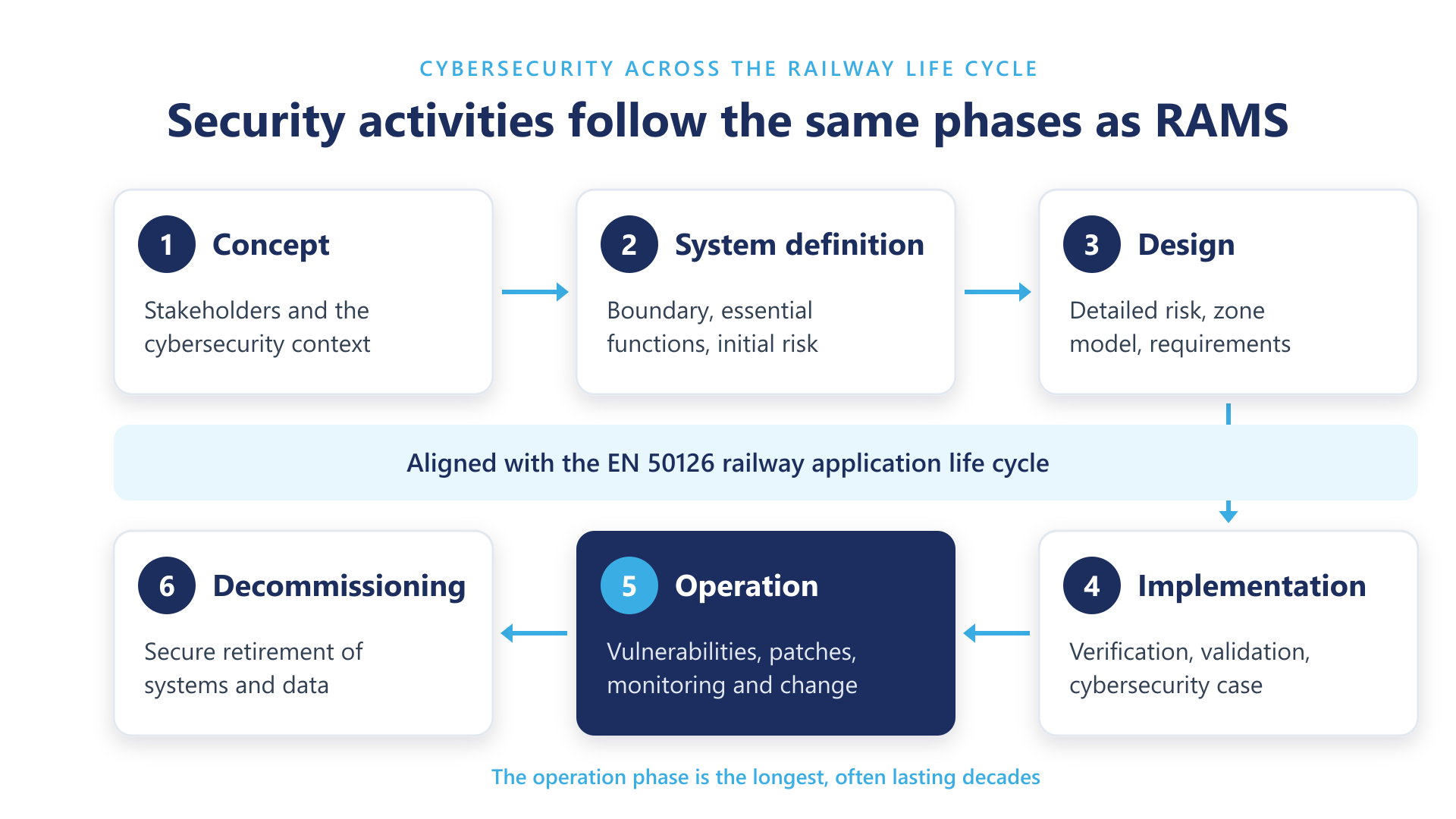
Practical implication: Cybersecurity can be approved through the same project gates as safety and reliability.
3. Zoning
A railway system is partitioned into zones such as the signalling core, the control centre, fixed installations, rolling stock, passenger services and business IT. Safety-related assets are placed in dedicated zones, and older equipment that cannot be hardened is commonly isolated in its own zone.
Practical implication: The zone model drives every later decision and is difficult to correct after the system is built.
4. Risk Management
An initial risk assessment rates the potential impact of a compromise. A detailed assessment of each zone and conduit then sets the target security level. ENISA notes that signalling zones typically receive SL 3, and sometimes SL 2.
Practical implication: The strongest measures are applied where the consequence of compromise is greatest.
5. Cybersecurity Requirements
Risk assessment results become requirements that flow from the asset owner to the integrator, and from the integrator to each supplier, so that every party knows what it must deliver.
Practical implication: Requirements written into a tender cost considerably less than security added after design.
6. Supply Chain Management
The standard sets out how cybersecurity responsibilities are agreed and verified across suppliers, in line with IEC 62443-4-1 and 4-2 and wider OT supply chain security.
Practical implication: As the DSB incident showed, the security of a railway service depends on its suppliers.
7. Cybersecurity Assurance
Verification, validation and the cybersecurity case provide evidence that can be reviewed by the asset owner, an assessor or a regulator.
Practical implication: Evidence that can be examined supports system acceptance, regulatory review and future audits.
8. Operation, Maintenance and Decommissioning
The operational phase is the longest phase of any railway system. Requirements cover vulnerability and patch management, monitoring, incident handling, secure change and secure decommissioning. Options for systems that cannot be patched are explained in our article on securing legacy OT systems.
Practical implication: Security achieved at acceptance must be maintained for decades.
9. The Relationship with Safety
IEC 63452 does not set safety requirements, but it explains how the cybersecurity and safety processes interact, so that a security change to a safety-related system is assessed for its effect on safety.
Practical implication: Cybersecurity and safety teams need a shared process, so that security changes do not undermine safety approval.
Common Findings
From Beacon Security's assessment work across industrial control environments, these gaps are the most relevant to IEC 63452:
- Security that ends at commissioning: Responsibility for the operational phase is often not yet assigned.
- Asset inventories that are out of date: Project records are frequently not maintained afterwards. See our article on OT asset discovery.
- Undocumented connections: Maintenance links and vendor remote access often sit outside the documented architecture. See our article on securing remote access.
- Separate safety and security processes: Security changes to safety-related systems are sometimes made outside a joint review between safety and security teams.
- Supplier obligations not yet defined: Contracts often do not specify security update obligations for the full service life.
How Beacon Security Can Help
Reading a new standard is one task. Knowing what it means for a specific line, fleet or product is a considerably harder one. Beacon Security specialises exclusively in OT security and applies the IEC 62443 principles on which IEC 63452 is built.
- Discover: We identify the assets, zones, conduits and external connections of your railway systems.
- Assess: We assess your programme against CLC/TS 50701 and IEC 63452 and identify the gaps.
- Prioritise: We rank the gaps by their consequence for safety and service.
- Sustain: We support requirements, remediation, training and monitoring as the standard is adopted.
What you receive: You receive a clear view of your railway cybersecurity position, a zone and conduit model, a prioritised gap register, and cybersecurity requirements that can be used in procurement.
Our services include risk assessment, gap assessment, cybersecurity design, product security and cybersecurity implementation.
Next Steps
If you would like to understand how IEC 63452 applies to your railway systems or products, please use the Book a Free 15-Minute 1:1 Call button on this page. The call is free of charge and without obligation.
This article is based on publicly available information about IEC 63452 at the Final Draft International Standard stage, as of November 2026. The content of the published standard may differ. Until IEC 63452 is published and adopted, CLC/TS 50701:2023 remains the current railway cybersecurity specification in Europe.